
The simulation of natural catchment areas requires calculating the processes of runoff generation, distribution and concentration. The methods of calculation used are described below.
Stress determination
The areal precipitation is the stress on a Sub-Basin element. In Talsim, each Sub-Basin uses only one precipitation source to represent the stress on the catchment. If there are several precipitation measurement stations in the catchment area, you can either divide the area into several sub-basins or aggregate precipitation sources, until only one precipitation source can be assigned to each element.
Runoff Generation
Runoff generation determines the amount of effective precipitation from the rainfall. From this, the components surface runoff, infiltration, evaporation and interflow are derived. By default, snow calculation is carried out at temperatures below zero °C and is based on the Snow-Compaction-Method. Regarding the algorithms of the method, reference is made to the relevant literature. The natural process from precipitation to runoff is divided into individual phases for the mathematical simulation. In the runoff generation phase, the precipitation (system load) is divided into the "effective precipitation" which is transformed into runoff, and the losses not affecting runoff (wetting, depression, evaporation and infiltration losses). Therefore, this phase is also called load distribution. The resulting mathematical equation for the momentary load distribution is as follows:
where:
|
: |
effective precipitation |
|
: |
precipitation |
|
: |
Evaporation |
|
: |
Infilatration |
|
: |
Surface water storage |
|
: |
Snow storage |
In the following, the terms used in the equation and their calculation are explained in detail.
Precipitation P
Precipitation data must be provided to the simulation model in the form of time series. In principle, it is irrelevant whether the precipitation series is a block rain, a model rain, a time series of natural observed rainfall, a rain spectrum or a long-term rainfall time series. The appropriate load has to be selected depending on the objective of the simulation. The rainfall time series are either taken from the time series management of Talsim-NG or, when carrying out a short-term forecast, are generated by entering a duration, an amount and by selecting a model rain directly before a simulation.
Evaporation E
Evaporation has a double effect on runoff generation. On the one hand, the initial conditions in the catchment area (interception and depression storage on the surface as well as to a limited degree the soil moisture of permeable areas) are a result of the evaporation taking place before the considered precipitation event. On the other hand, the current runoff-effective precipitation is affected by the amount of the current evaporation rate.
The potential (energetically possible) evaporation Epot varies in time and place and is very difficult to calculate exactly.
Talsim-NG offers multiple options for entering/calculating potential evaporation:
•Specification of an external time series with values for the potential evaporation
•Internal calculation of potential evaporation: the potential evaporation can be calculated internally based on temperature and, depending on the method, additional parameters. The following methods are available:
oPenman: requires the specification of average patterns or of time series for sunshine duration, wind speed and relative humidity
oHaude: requires the specification of average patterns or of a time series for relative humidity
oTurc: requires the specification of average patterns or of time series for sunshine duration and relative humidity
oBlaney-Criddle: simplistic method requiring only the specification of a latitude which is used internally to derive the sunshine duration.
•Specification of a fixed evaporation rate per year: when using this option, the entered annual value is distributed inner-annually using the compensation function according to Brandt:
Annual and daily distribution functions for the evaporation
The following distribution functions by Brandt are used to distribute entered annual values for evaporation over the year and to convert daily values to hourly values.
Using evaluated measurements of 20 stations, the mean values of which are presented in the following histogram, the following compensation function was determined /BRANDT, 1979/.
where:
|
: |
|
|
: |
November 1st |
The total annual potential evaporation height in this sample is 642 mm. If no measured evaporation values are available, this normalized annual potential evaporation pattern can optionally be used to calculate the current evaporation. If the simulation time step is less than one day, the potential evaporation for each time step is additionally determined using the daily pattern displayed below. If the calculation interval is more than 1 day, the daily pattern is not taken into account.
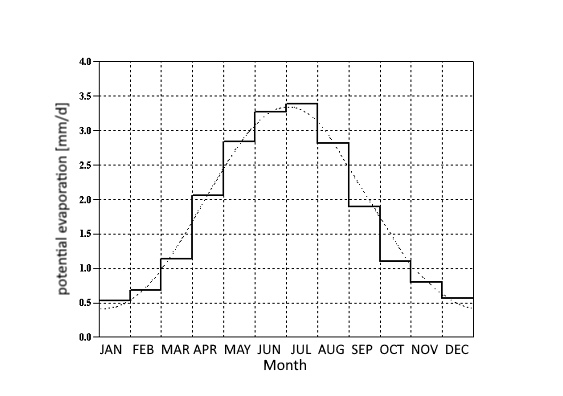 Annual pattern of potential evaporation according to /BRANDT, 1979/
|
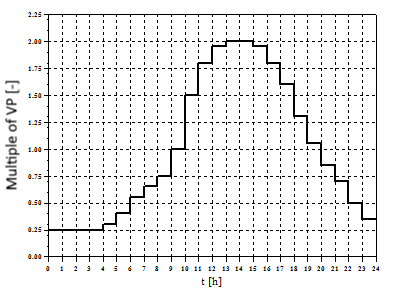 Daily pattern of potential evaporation as a scaling factor for the mean daily evaporation |
Surface water storage SSW
Surface water storage on impermeable areas
For impermeable areas, snow storage and infiltration can be neglected, so that the balance equation is simplified as follows:
The change in surface water storage represents the wetting of the surface as well as the filling and emptying (by evaporation) of depressions.
As wetting loss WL for impermeable areas the following standard value is set:
The depression loss DL is specified by the user. The default and at the same time the maximum value in the model is:
The Depression loss represents an average value for an sloped surface. Since depressions are not evenly distributed and runoff already begins before all depressions are completely filled, it is assumed that
•1/3 of the impermeable area has a reduced depression loss of 1/3⋅DL
•1/3 of the impermeable area has the average depression loss of DL
•1/3 of the impermeable area has an increased depression loss of 5/3⋅DL
Therefore, runoff already occurs when the precipitation reduced by the evaporation rate exceeds the wetting loss and 1/3 of the depression losses (in case of dry starting conditions).
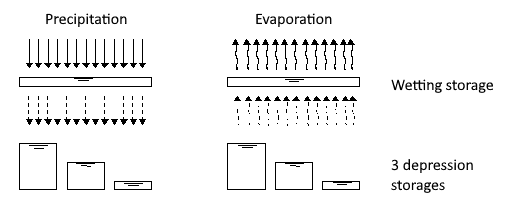
Scheme of wetting and depression losses
The runoff coefficient of the impermeable areas (after covering the initial losses) is set at . When determining the portion of impermeable areas for a sub-basin, you must take into account that not all paved or sealed surfaces actually drain into a sewer system. The continuous provision of wetting and depression losses is achieved by continuously balancing the corresponding storages and the evaporation.
Surface water storage on permeable areas
The surface water storage of permeable areas is calculated by balancing a loss storage depending on the selected runoff generation approach. Details can be found in the following sections on the calculation of infiltration and runoff-effective precipitation.
Infiltration I and effective precipitation Peff
In the case of permeable areas, infiltration into the soil cannot be neglected, since this has a decisive influence on the runoff. For the calculation three approaches are implemented in the model:
1.Constant discharge coefficient Ψ
2.Event-specific discharge coefficient based on the Soil-Conservation-Service (SCS) method
Constant discharge coefficient Ψ
The constant discharge coefficient is a scaling factor to derive the effective precipitation. After covering the initial losses (wetting and depression losses) the remaining part of the precipitation is multiplied with the constant discharge coefficient to get the part of the precipitation that will become runoff.
|
Very simplistic method. Infiltrated water is not taken into account. Antecedent conditions and characteristics of the rainfall event (amount, intensity, duration) are not taken into account. Do not use this method for continuous simulation. Only use this method for event based simulation and only if data availability does not allow for using a more sophisticated method. |

Event-specific discharge coefficient based on the Soil-Conservation-Service (SCS) method
Using a CN value that is dependent on the soil type and land use (see /DVWK, 1991/), the initial losses and a relationship between the runoff coefficient and the accumulated rainfall amount up to the current point in time can be derived, both of which are dependent on antecedent conditions /Zaiss, 1987/. With this approach, the runoff coefficient increases with increasing precipitation amount during the course of the rainfall event. The quantification of the antecedent conditions is based on the 21-day-precipitation index VN.
where:
|
: |
Precipitation amount of the j-th previous day |
|
: |
Factor describing the influence of the j-th previous day |
The impact of different seasons is represented by an annual pattern of the factor C.
where:
|
: |
current day of the hydrological year |
As a result, the value of C ranges between 0.8 < C < 0.9. This ensures that different rainfall indices are calculated for the same amount of rainfall at different times of the year, thus taking into account different degrees of runoff readiness. Depending on the antecedent conditions quantified in this way, a current discharge coefficient can be calculated using the CN values specific to the area and valid for average previous conditions. The following figure shows how the current discharge coefficient for different CN-values changes depending on antecedent conditions. Since the runoff readiness of a catchment area changes during the course of a rainfall event due to soil moistening, the runoff coefficient is also adjusted during an event as a function of the cumulative precipitation amount.
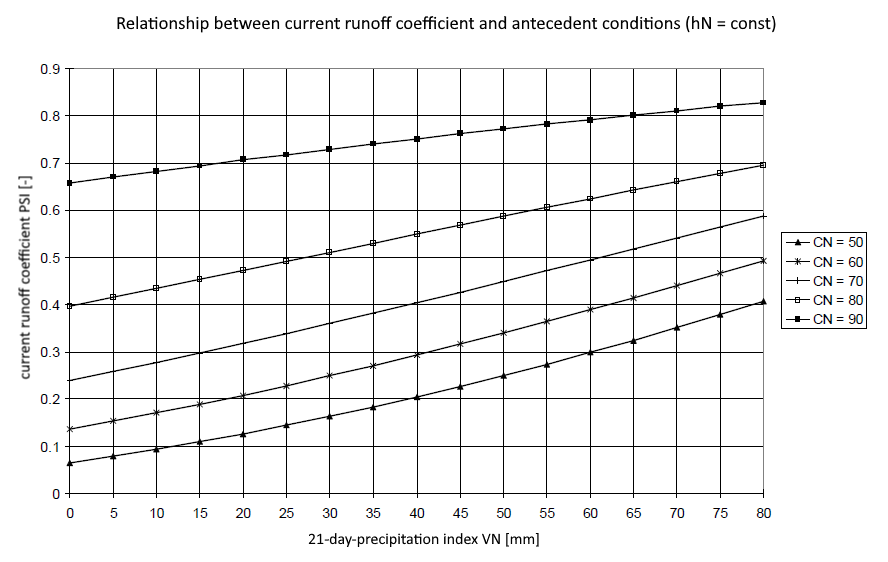
Dependence of the runoff coefficient on antecedent conditions
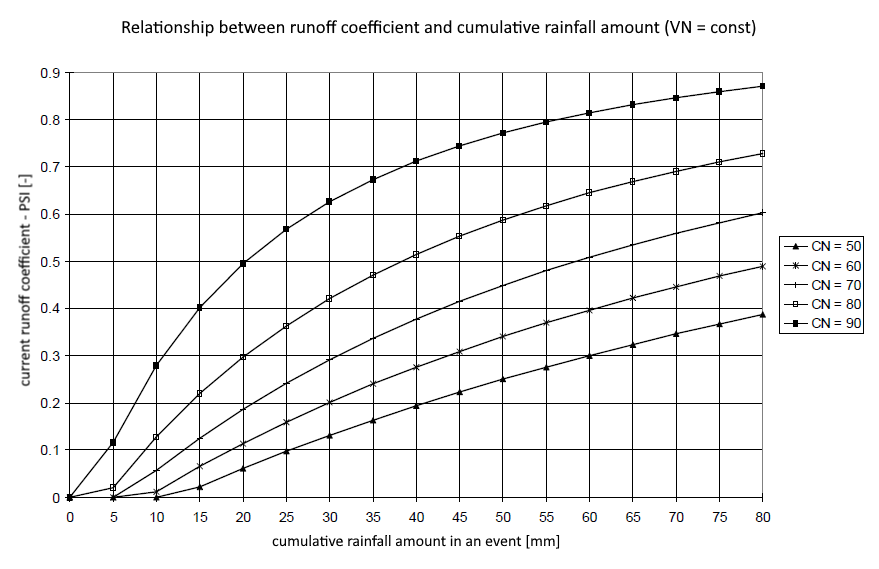
Dependence of the runoff coefficient on the cumulative precipitation sum
|
Very simplistic method. Infiltrated water is not taken into account. Do not use this method for continuous simulation. Only use this method for event based simulation and only if data availability does not allow for using a more sophisticated method. |
Soil Moisture Simulation
Land Use
When using soil moisture simulation, it is necessary to specify the land use. From the information about land use, the root depth is needed to determine the thickness of the root layer. Further parameters of land use, which are used to calculate interception and transpiration, are
•Root depth [m]
•Coverage [%]
•Annual pattern of coverage
•Leaf area index [%]
•Annual pattern of the leaf area index
•Land use impacts on soil density (BD = Bulk Density)
•Kc-values
•Roughness
Haude factors entered as annual patterns can be assigned to each land use for a better consideration of the evaporation.
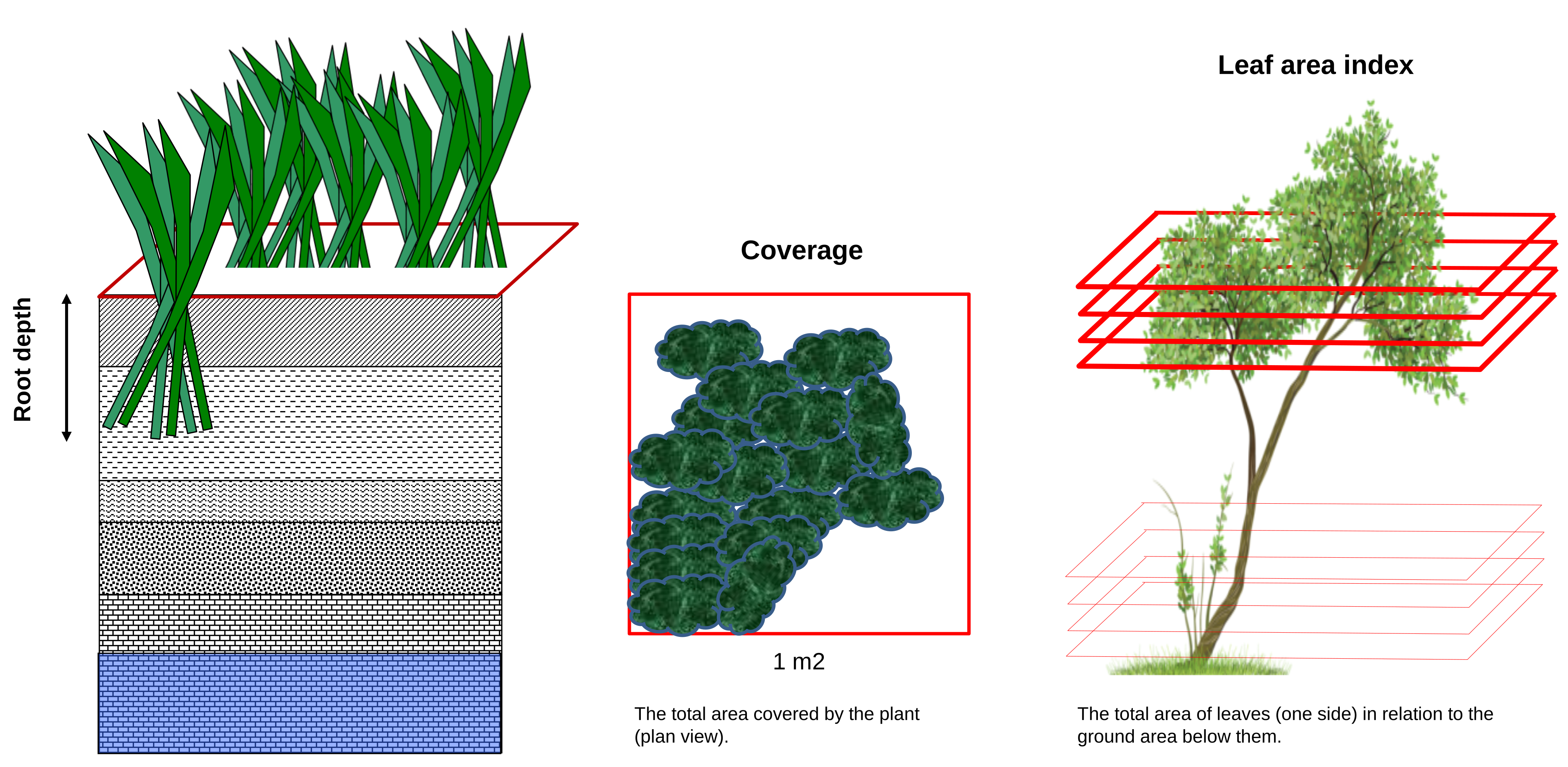
Landuse parameter
Soil
The soil moisture simulation is based on a non-linear calculation of the individual soil layers. The soil is divided into different layers. Each layer is calculated individually and inflows and outflows reconciled with the layers below or above (if present). The following physical soil parameters are used as parameters for the soil moisture calculation:
•Wilting point (WP)
•Field capacity (FC)
•Total pore volume/ Saturation (SAT)
•Saturated conductivity (kf value)
•Maximum infiltration capacity (max. inf.)
•Maximum rate of capillary suction (max. cap.)
•Soil categorization: sand, silt, clay
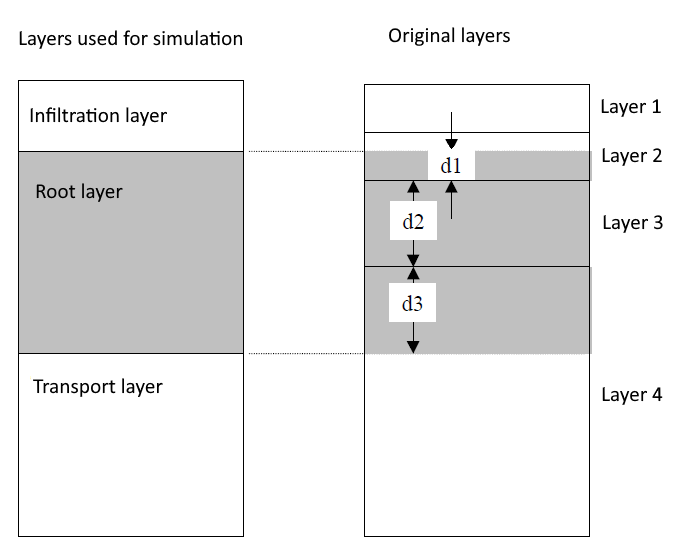
Aggregation of soil layers to simulation layers
The possible number of soil layers ranges from a minimum of one to a maximum of six. Experience has shown that the best results are achieved with a division into three layers. For this reason, the entered layers are always internally divided into three simulation layers:
•Infiltration layer (standard thickness [cm] = 20)
•Root layer (minimum thickness [cm] = 5)
•Transport layer (minimum thickness [cm] = 5)
The calculation of soil properties for the simulation layers is done by weighting them according to the given original thicknesses of the layers. In case of saturated conductivity the calculation is based on the principle of maintaining the continuity of the flow. For vertical flow, the velocity v at a given flow rate in one simulation layer should have the same value due to the continuity of the flow. Thus, the hydraulic gradient is no longer constant.
where:
|
: |
proportional layer thickness of the respective original layer [mm] |
|
: |
saturated conductivity of the respective original layer [mm/h] |
|
: |
saturated conductivity of the simulation layer [mm/h] |
The water balance equation for a soil layer is solved on the basis of the piece-wise linear representation of the process functions which influence soil moisture: infiltration, current evaporation (evaporation + transpiration), percolation, interflow and capillary suction. The input variable for evaporation and transpiration is determined from the potential evaporation. The equation to be solved is:
where:
|
: |
current soil moisture |
|
: |
infiltration into the soil |
|
: |
percolation (seepage) |
|
: |
actual evaporation |
|
: |
actual transpiration |
|
: |
interflow |
|
: |
capillary suction |
Infiltration, percolation, evaporation, transpiration, interflow and capillary suction depend on the current soil moisture. In the simulation, this dependence is described by the following functions.
where:
|
: |
infiltration factor by HOLTAN (in Talsim |
|
: |
hydraulic conductivity of the saturated soil |
|
: |
Total available water |
|
: |
wilting point |
|
: |
field capacity |
|
: |
total pore volume/ saturation |
|
: |
soil-dependent scaling factor of the percolation function |
|
: |
soil-dependent curvature parameter of the percolation function |
|
: |
soil-dependent scaling factor of the evaporation function |
|
: |
soil-dependent scaling factor of the transpiration function |
|
: |
curvature parameter of the transpiration function |
These parameters are calculated internally. The user only has to specify the soil parameters kf, WP, FC and SAT. The soil processes are solved using a component for the simulation of storage.
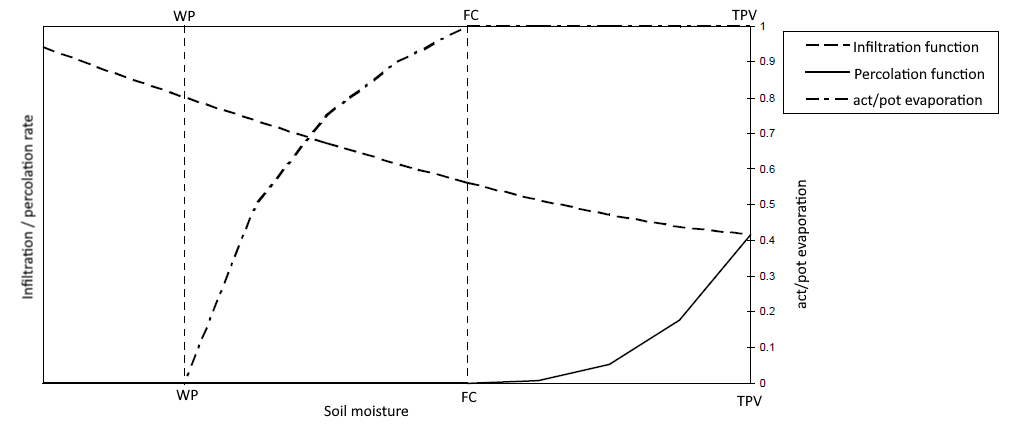
Selected soil process functions
Hydrologic Response Units
When runoff generation is calculated using soil moisture simulation, the concept of hydrologic response units (HRUs) is applied. A catchment area is divided into a number of hydrologically homogeneous areas, i.e. areas of the same soil type and the same land use. For each hydrologic response unit there is exactly one assignment of land use and soil type. The discharge resulting from a hydrologic response unit is output from the sub-basin element to which the HRU belongs, i.e. all hydrologic response units release discharge with the same time delay, independent of their location within the sub-basin.
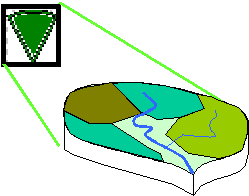 Division of a sub-basin element into hydrologic response units |
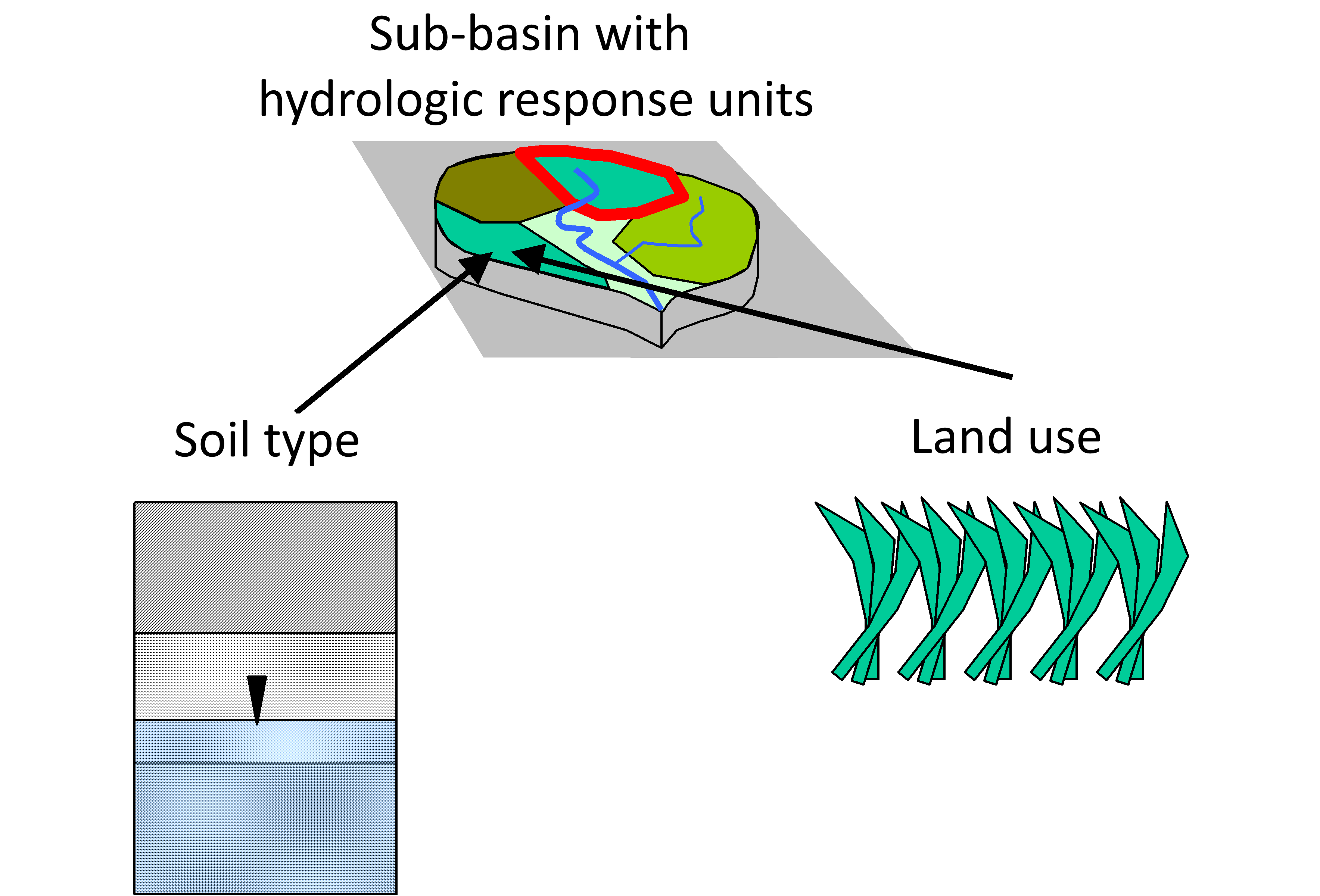 Assignment of soil type and land use to hydrologic response units |
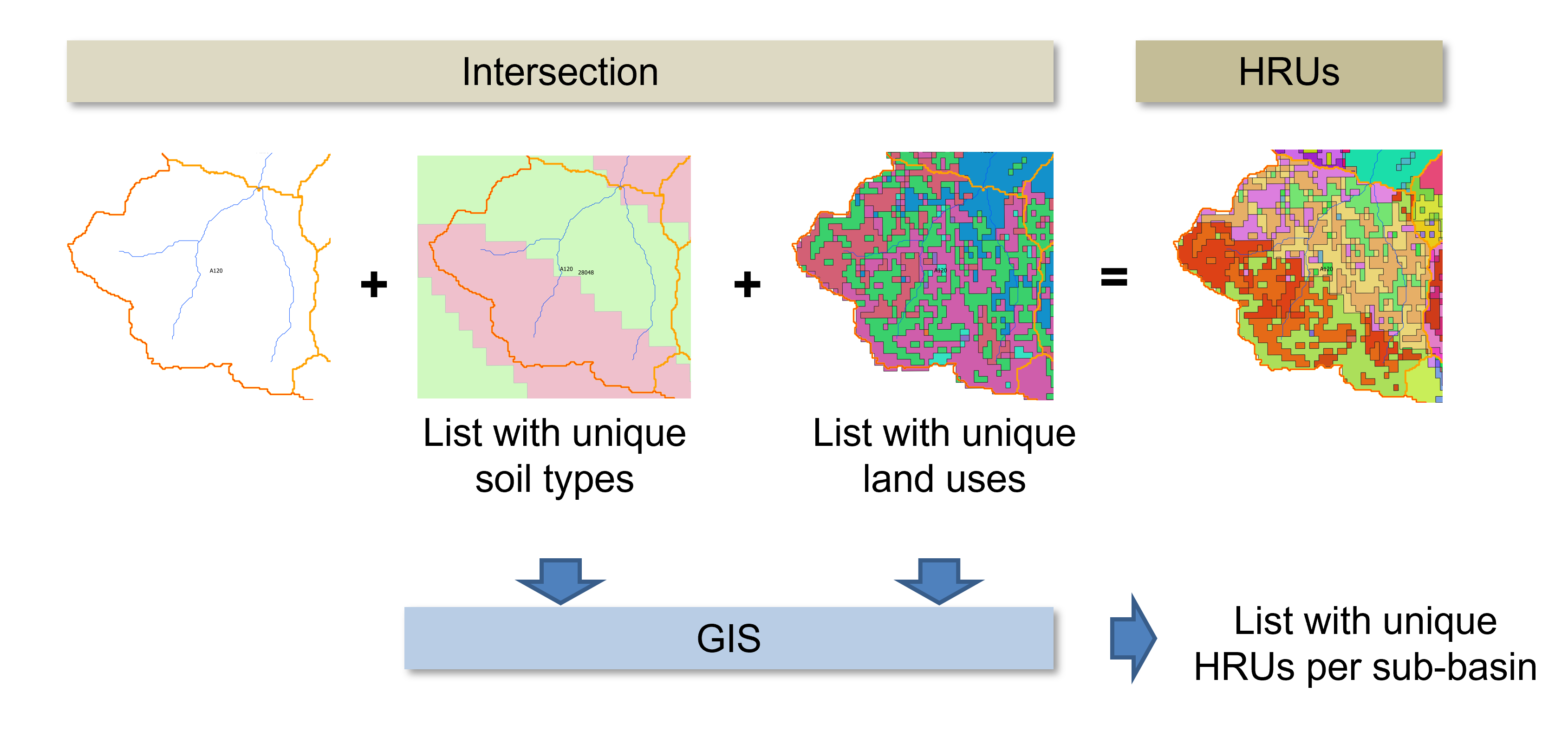
Hydrologic Response Units (HRU) as the intersection of land use and soil type of a SubBasin
Runoff Concentration
Runoff concentration determines the delay of runoff from the catchment area. A parallel storage cascade with three reservoirs for permeable and one cascade for impermeable areas is used for surface runoff. The outflow of the components interflow and baseflow is output at the element outlet after passing through a single linear storage.
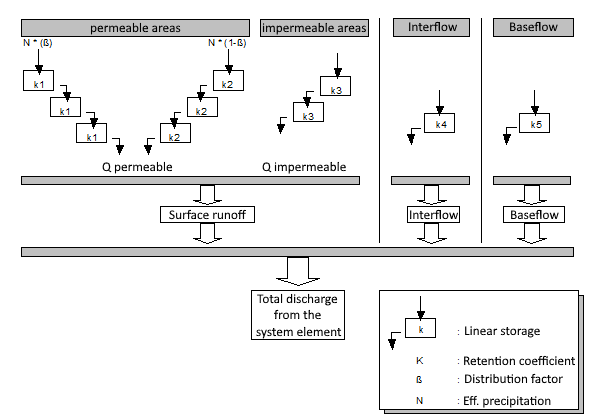
Calculation of the runoff concentration in SubBasins