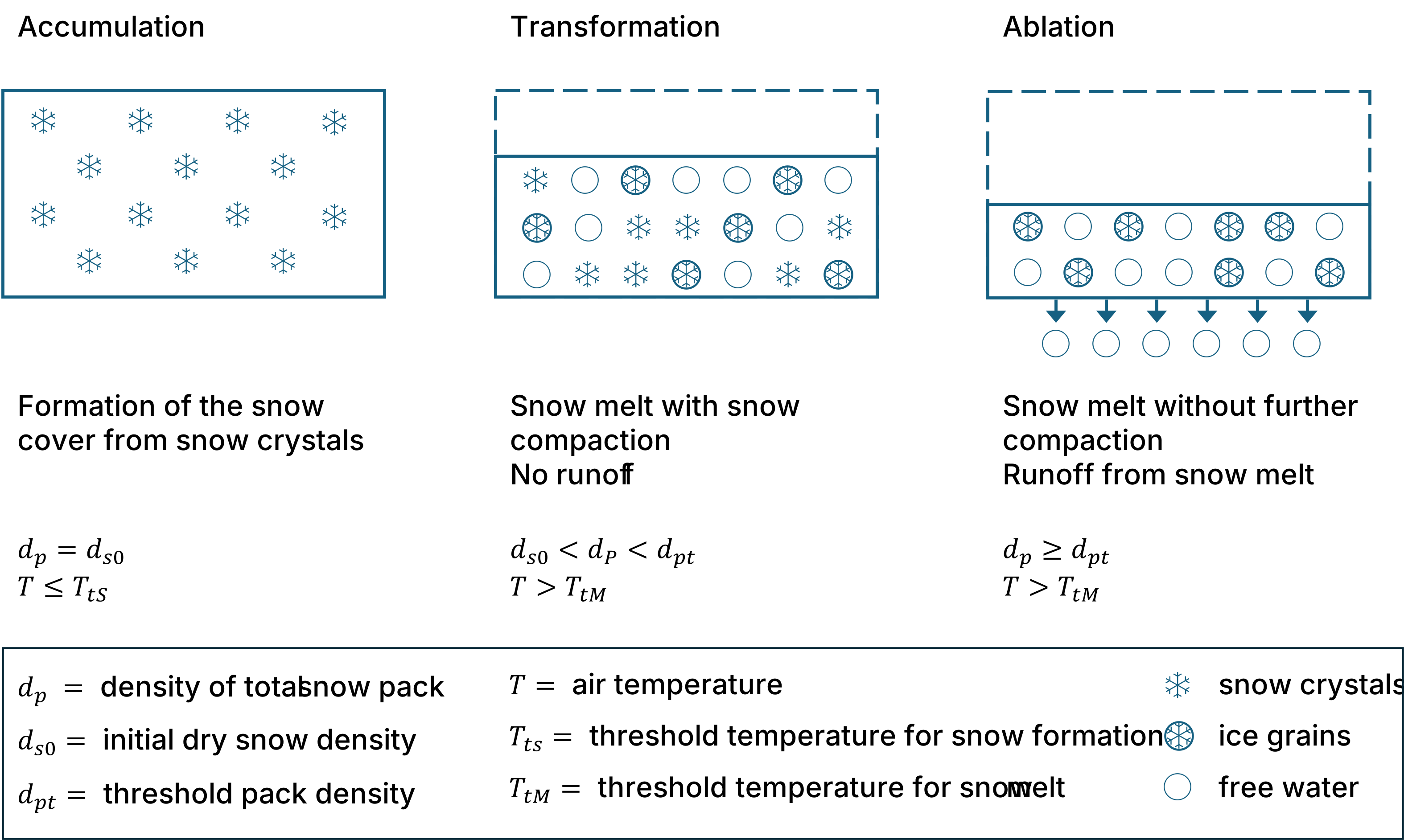
The accumulation and melting of snow in a Sub-Basin is internally computed in Talsim using a combination of the snow compaction method (BERTLE) with a simplified heat balance model to estimate the potential melt rate.
The evolution of the snow cover is thereby structured into three phases (s. figure):
1.Accumulation: when air temperature is below or equal the threshold snow formation temperature (Default: 0°C) precipitation falls as snow. The snow falls with the snow density for fresh snow (Default: 11%). A snow cover builds up.
2.Transformation: when air temperature is above the threshold temperature for snowmelt (Default: -1°C) and no precipitation occurs the snow cover starts to melt and free water is formed. When temperatures are above the threshold temperature for snow formation by rainfall (Default: 0°C) free water is formed both by melting of the snow cover and by added rainfall. The free water by rain and/or melt water does not lead to runoff immediately but is retained within the snow cover, thus compacting the snow and increasing pack density. Free water is retained until the threshold pack density of the snow cover (Default: 40%) is reached.
3.Ablation: after reaching the threshold pack density the snow cannot retain any additional melting water or rain and runoff occurs.
snowmelt rate due to radiation and soil heat flow [mm/d] (Default: 4.2)
:
rainfall [mm/d], equals precipitation for , otherwise 0
:
temperature of rainfall [°C], is assumed to be equal to air temperature
The parameter and are not physical constants but can be used as calibration parameter for a catchment. KNAUF recommends a range for between 2.4 and 24 mm/d.
The snow compaction equations by BERTLE are based on laboratory experiments. The empirical relationship between the relative snow compaction and the relative water equivalent was found to be a linear regression curve and is used in Talsim as follows:
where:
:
snowpack depth after compaction in percent of dry snow depth before compaction
:
accumulated water content in percent of dry snow water content
With the compaction of the snow the pack density rises until reaching its threshold density. Given a certain threshold density and the density of the initial dry snow pack the following threshold valued can be computed:
where:
:
value of when the snowpack is at its threshold density
:
value of when the snowpack is at its threshold density
:
initial dry snow density of the snowpack in percent (Default: 11%)
:
threshold density of compacted wet snowpack in percent (Default: 40%)
:
threshold density of dry snow in compacted wet snowpack in percent
Threshold snowpack densities range from 40% to 45% (BERTLE). The default threshold density in Talsim is 40%. It can be used as a calibration parameter.
Fresh snow densities often lie in a range between 5% to 20% (KNAUF). The default fresh snow density in Talsim is 11%. It can be used as a calibration parameter.
In the following example the evolution of a snow cover is both illustrated and the parameter describing the snow cover are computed (modified from KNAUF). It shows the evolution of the snow cover from its initial state at the end of snow accumulation (a) in the transformation phase with melting, rainfall and compaction (b) at its the threshold state (c) to the ablation phase (d). Note that despite the melting and rainfall in (b) and (c), no water is released from the snow cover up to the threshold state. Only with further melting and/or rainfall the retention capacity of the snow cover is exceeded and water is released. After exceeding the threshold value for the pack density even more water than the melting rate suggests can be released as the snow reservoir is emptied. Although in (d) only 19.6 mm of the snow melts 40 mm of water are released in total:
Snow compaction calculation example
The water release out of the snow cover computed with the snow compaction method is not necessarily direct runoff at the Sub-Basin outlet.
After being released by the snow cover the water still undergoes the processes of the soil moisture computation (infiltration,... ) and runoff concentration.
Talsim only supports the internal snow computation at the moment.
The option to provide external time series for the water release and/or the snow depth are being implemented and will be included in future releases.
Literature
BERTLE, F.A, 1966: Effect of Snow-Compaction on Runoff from Rain on Snow, in: Bureau of Reclamation, Engineering Monograph No. 35, Washington
KNAUF, D. 1980. Die Berechnung des Abflusses aus einer Schneedecke, in: DVWK-Schriften, Heft 46, Analyse und Berechnung oberirdischer Abflüsse